
The book
Set Up to Care
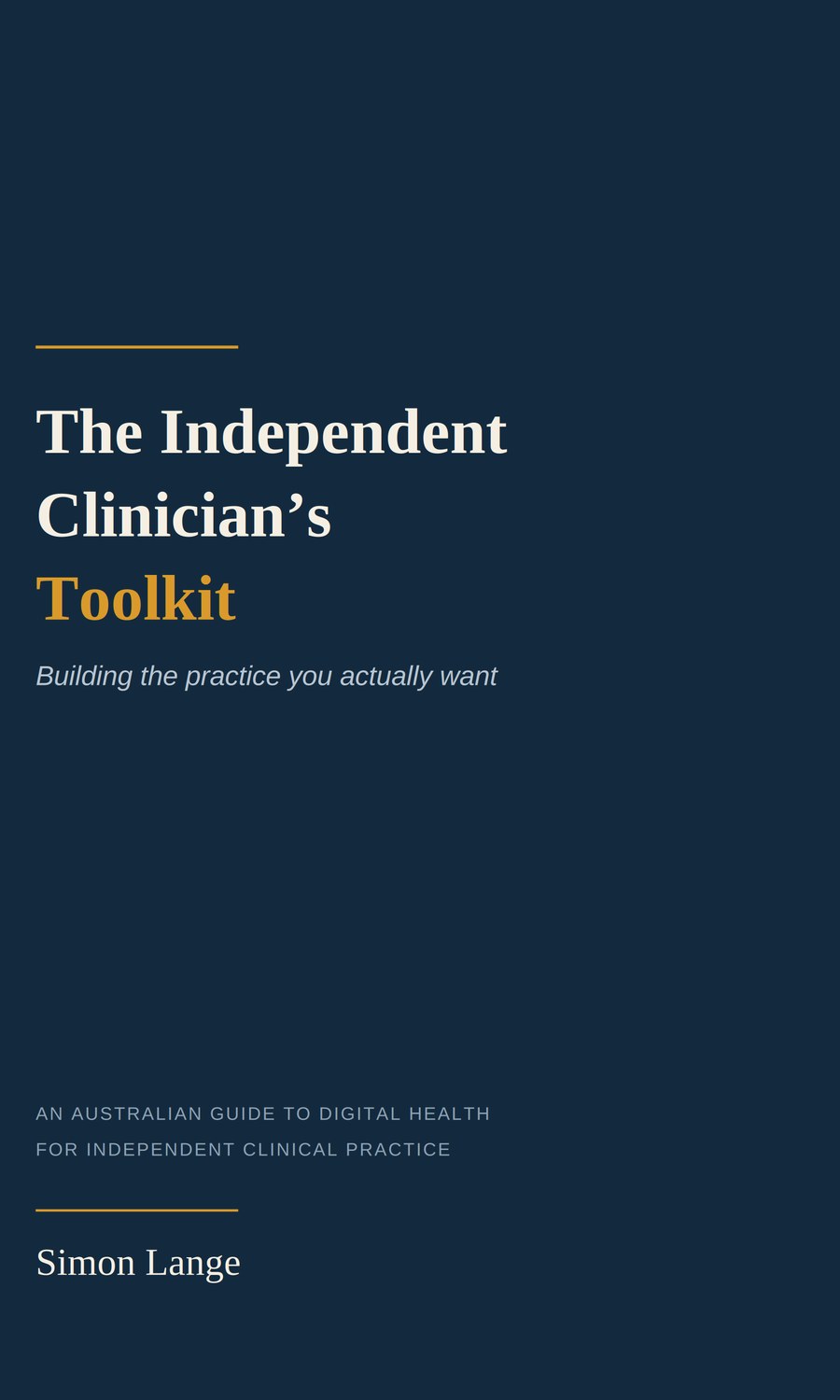
A clinicians' guide to getting your digital health set-up working for you
A practical Australian guide for clinicians whose digital set-up is nobody else's job. You've installed the software and kept the day running. This is how to set it up so it works for you.
The opening
It's 5:23 on a Tuesday afternoon.
In a regional town four hours from a capital city, Nadia has just finished with her last client. She is a psychologist, working alone in two rooms above a pharmacy. Her notes are written. They were written during the session, inside a template she built for this kind of presentation. The claim went through while the client was putting their coat on. She closes her laptop at 5:31 and does not open it again.
In an outer-suburban shopping strip, Marcus and Jen, two GPs, are finishing a Tuesday with no unfinished notes. In an inner-city allied health practice, Anna, principal of nine clinicians, is not staying late either. Three practices, three scales, one Tuesday.
Not so long ago, none of it was true. What changed was not one tool. It was an approach, and it is the same at all three scales.
This is what the book is about: not what you're escaping, but what you're building.
Why this book is different
The numbers are in the book. They are not the reason.
Most writing for clinicians opens with the percentages: the burnout rates, the lost revenue, the compliance risk. You already know what the gap costs. This book includes the Australian data because it matters, but it does one job with it: sizing the gap between how most practices run and how yours could.
Fear is a fast motivator and a poor architect. It builds defences, not destinations. Your reason for reading is the practice you pictured when you decided to do this work.
What's inside
Part I: The practice you're building. An ordinary Tuesday, and the five foundations that make it possible.
Part II: Building the foundations. A connected practice. The defensible record. The frictionless patient journey. Charging what you're worth. The confident biller. Care beyond the consulting room.
Part III: Protecting and extending what you've built. A practice patients choose. The AI-augmented practice, where AI genuinely helps and where it becomes a regulated medical device. Earned trust: cybersecurity in plain language, and where practices actually fail.
Part IV: Putting it into practice. Building without breaking things, a sixteen-week implementation. The practice that outlasts you.
Every chapter ends with a Care Plan: what you are building, what to do this week, and a short checklist. Technical terms are explained in plain language as you go.
Where the book states a figure or a rule, the source is listed chapter by chapter, with links, on Sources and further reading.
Who it's for
Clinicians in any discipline, in practices of any size outside the large health systems: the solo psychologist, the two-GP practice, the allied health principal with nine clinicians behind her. Whether or not your name is on the lease.
Who it isn't for
It won't tell you how to practise. I'm not a clinician, and the book says so up front. If you're looking for clinical guidance, this isn't it. It's about everything that surrounds the clinical work — and how, arranged properly, that gives you the time and headspace to do the clinical work itself.
On tools
Clinicians are constantly being sold methods as identities. “We are a Best Practice clinic.” “We use HotDoc.” “We are certified in the Essential Eight.” These are not identities. They are tools. Some are excellent. None of them is the practice.
This book won't convert you to a brand. It shows you the categories of tools available and helps you develop the judgement to choose between them. I resell nothing and have no commercial relationship with any platform named in it.
Start with the free sample chapters
The Introduction, a note from me, and the first two chapters: An ordinary Tuesday, which shows the practice you're building, and The five foundations, with a short self-assessment that shows you where to start. It's the fairest test of whether the rest of the book is for you.
Where to buy
Get the book
Publishing late 2026. The first chapters are free above, and the notes list below is the way to hear when the book is available.
The practice you want and the practice you have are not separated by a complete rebuild. They are separated, in each of the areas this book describes, by a small number of well-chosen changes, made deliberately. Not the rebuild. The adjustment.
Occasional notes on digital health that's actually working
A few times a year, when I have something useful to say. No sequences, no funnels, no “quick question, Simon?” emails.